Orkney’s inter-island ferries are an essential part of getting around the archipelago once you leave the mainland routes from North Scotland. While most visitors arrive via Stromness or Kirkwall, the wider experience of the Orkney region only really opens up when you start travelling between the islands themselves.
Unlike the main ferry crossings to Orkney, these services are smaller, more local, and operate as part of everyday transport for island residents. They connect communities, move goods, and provide the only practical link for many islands. For visitors, this means the system feels different from typical tourist transport and requires a bit more planning. Once you understand how the network is organised, however, it becomes one of the most rewarding ways to explore Orkney.
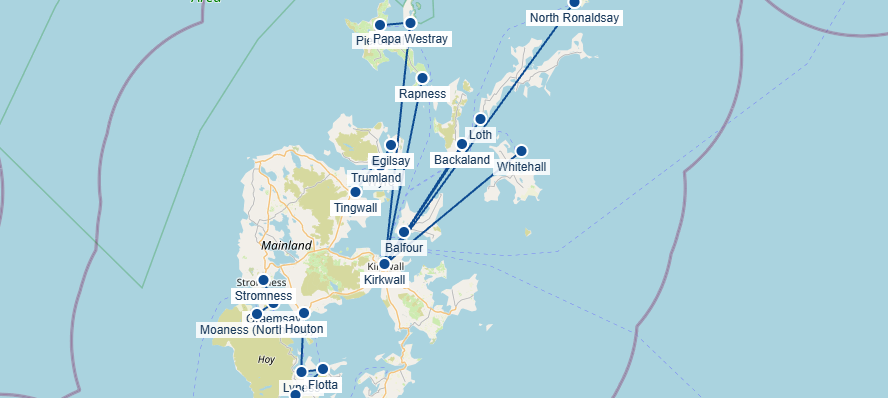
Island Network Overview
The inter-island ferry system connects fifteen inhabited islands, each with its own identity and level of accessibility:
- Hoy (article about visiting the island)
- Westray and Papa Westray
- Rousay, plus Egilsay and Wyre
- Shapinsay
- Sanday, Stronsay and Eday
- North Ronaldsay
- Flotta and Graemsay
- South Ronaldsay
These islands are all connected through services mostly operated by Orkney Ferries, although the frequency, duration, and style of crossings vary significantly between routes.
Ferry Crossings Structure
Rather than operating as one continuous system, Orkney’s inter-island ferries are divided into regional route groups. Most services begin from Kirkwall, which acts as the main hub for island connections. From here, ferries branch out in different directions depending on geography.
Shapinsay is the closest and most frequently served island, with short crossings that make it ideal for day trips. This route is often the simplest introduction to inter-island travel.
To the north, the “North Isles” routes connect Kirkwall with Westray, Papa Westray, Sanday, Stronsay, Eday, and North Ronaldsay. These services can be direct or multi-stop, with ferries calling at several islands in sequence before returning to Kirkwall. Journey times vary depending on the number of stops.
To the west of the mainland, Rousay is linked with Egilsay and Wyre. These are shorter crossings and tend to be more predictable, making them suitable for straightforward day visits.
Further south and west, Hoy, Flotta, and Graemsay are connected by separate routes. Some sailings depart from mainland terminals rather than Kirkwall, so the departure point is an important detail when planning.
South Ronaldsay is slightly different, as it is connected by road via the Churchill Barriers rather than being fully reliant on ferry services, although it is still part of the wider island network.
How the Ferry System Works
The inter-island ferry system is designed primarily for local use rather than tourism, which shapes how it operates. Each route has its own timetable and operating pattern. There is no single unified schedule covering all islands.
Some routes are direct point-to-point crossings, while others include multiple stops along the way. This is particularly common on the North Isles routes, where ferries may call at several islands before returning to Kirkwall.
As a result, journeys are not always straightforward. Travelling between islands may require timing connections carefully, and in some cases, returning to the mainland before continuing onward.
One important point is that inter-island ferries are designed around connection rather than convenience. Many routes exist primarily to link small communities to essential services in Kirkwall or other hubs, so schedules are shaped more by practical needs than visitor demand. This affects departure times, stop patterns, and even which days certain islands are served.
On some routes, especially in the North Isles, ferries operate in a circular pattern, calling at multiple islands before returning to the mainland. This allows movement between islands, but it also means journey times can vary depending on direction and the number of stops on a given sailing.
It is also common for the same route to operate differently on different days. A sailing might run directly on one day and include additional stops on another, depending on operational requirements. This variability is normal and reflects how the ferry network adapts to the needs of residents across the islands.
For visitors, the key point is that there is no fixed “tourist schedule” to rely on. Each journey needs to be checked individually using the latest timetable, with the expectation that routes function as flexible transport links rather than fixed services.
Frequency also varies widely. Shapinsay may have several sailings per day, while more remote islands like North Ronaldsay may only have limited weekly services. This variation is one of the most important factors when planning any island visit.
Boarding is generally simple. Terminals are small and efficient, and the process is less formal than at mainland ferry ports. Vehicles are accepted on many routes, but advance arrival is still required. Because ferries also carry freight and supplies, schedules can reflect operational needs as much as passenger demand.
Planning Your Journey
Timetables are the most important part of planning inter-island travel. As each route operates independently, services can vary depending on day and season. To check detailed timetables, see here: https://triprug.com/orkney-ferries.htm. When planning a trip, it is essential to check both outbound and return sailings together. Some islands do not have multiple return options on the same day, which can significantly affect how long you can stay. For more remote destinations, overnight stays are sometimes the only realistic option if you want meaningful time on the island.
Which Islands Are Worth Visiting
Each island offers a different experience, and the best choice depends on time, access, and interest.
- Shapinsay is the easiest to reach from Kirkwall and works well as a short and simple day trip.
- Rousay is known for its archaeological sites and is one of the most accessible islands for visitors. It also connects with Egilsay and Wyre for extended trips.
- Westray and Papa Westray offer a more remote experience with wildlife, coastal scenery, and quiet island life.
- Hoy is one of the most dramatic islands, known for its cliffs, walking routes, and rugged landscape.
- Further afield, Sanday, Stronsay, Eday, and South Ronaldsay offer quieter and more remote experiences.
Most visitors benefit from choosing one or two islands rather than attempting to visit several in a short period, as ferry schedules naturally limit flexibility.
Making the Most of Orkney’s Ferry Network
Orkney’s inter-island ferries are simple to use once you understand how the system is structured. Each route operates independently, and planning revolves around checking timetables and working within limited sailing frequencies. The key is to choose islands in advance, build your itinerary around ferry times, and keep plans realistic. Once this is in place, travelling between islands becomes straightforward and reliable. For many visitors, these ferries are not just transport but part of the experience itself, opening up parts of Orkney that feel more remote, quiet, and distinctive than the mainland.